Digital Exhibition – Zappa
AN GORTA MÓR
The Great Hunger
Background

The Great Hunger (an Gorta Mór) occurred in the late 1840s across the island of Ireland. Over the course of seven years, one million Irish died and two million emigrated. It began with potato crop failures due to the infestation of a fungus, but the impact was increased by a lack of adequate response by the colonial British government. As you will see in this exhibit the combination of agricultural mono-culture, indifferent aristocracy, and an oppressive colonial government led to one of the biggest civilian death tolls in modern history.
Map Of Ireland
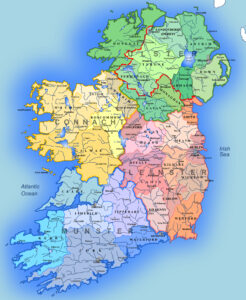
The Great Hunger (an Gorta Mór) occurred in the late 1840s across the island of Ireland. Over the course of seven years, one million Irish died and two million emigrated. It began with potato crop failures due to the infestation of a fungus, but the impact was increased by a lack of adequate response by the colonial British government. As you will see in this exhibit the combination of agricultural mono-culture, indifferent aristocracy, and an oppressive colonial government led to one of the biggest civilian death tolls in modern history.
For further reading click on the documents on the left, the pdf will then be opened.
The Potato in Ireland

Stack of Potatoes, Irish Times, 23 July 2013
At the time in history when The Great Hunger occurred, Ireland was growing many varieties of crops and livestock, but most of the lower classes were only permitted to grow and eat potatoes. In good years this meant they had a food source rich in all the molecules people need to survive. But when potato crops failed, they had nothing. With this level of mono-culture, Ireland was begging for a potato blight (a fungus that kills potato plants). And that is exactly what happened.
Effects
Landlords and Tenants
A legacy of the British takeover of Ireland is that very few Irish people owned the land on which they lived. And once the potato crop failed, Irish laborers had to spend all their money on alternative food sources, and had no money for their rent. This led to ejectments en masse. Most of the landlords were British, and did not live in Ireland. They had hired Irish men, some homeless themselves, to perform the ejectments and occasionally destroy the structure so no peasants could shelter there for free. This obviously worsened the problems facing the Irish peasants by ridding them of a roof to sleep under and walls to protect them from the wind.
“The fearful system of wholesale ejectment, of which we daily hear, and which we daily behold, is a mockery of the eternal laws of God– a flagrant outrage on the principles of nature. Whole districts are cleared. Not a roof-tree is to be seen where the happy cottage of the labourer or the snug homestead of the farmer at no distant day cheered the landscape.”(Illustrated London News, 16 December 1848)

The Ejectment, Illustrated London News, 16 December 1848.

After The Ejectment, Illustrated London News, 16 December 1848.

Beggar-Woman and Children, Illustrated London News, 12 August 1843
Following ejectment, the only hope a family had to buy food was to beg. Thus, a traveler in Ireland during this time period could expect to see old men, women, and children lining the roads in hope of whatever charity might come their way. The article on the left details the lengths people were willing to go just for the smallest coin.
British Actions
Workhouses

Peasant at the Gates of the Workhouse, The Illustrated London News. 1846.

From the 5th Annual Report of the Poor Law Commissioners. 1838/1839.

An engraving in The Illustrated London News. 1846.
The workhouses were often harsh and involved intensive labor for meager wages. They were designed to instill and encourage a sense of self-reliance in the poor. The workhouses could hold up to 100,000 people, but because they were unpopular only about 40,000 lived inside their walls before the famine. As of January 1847, only two years into the famine, the number of people in the workhouses exceeded 100,000 (Kissane, 89)
Exporting Food
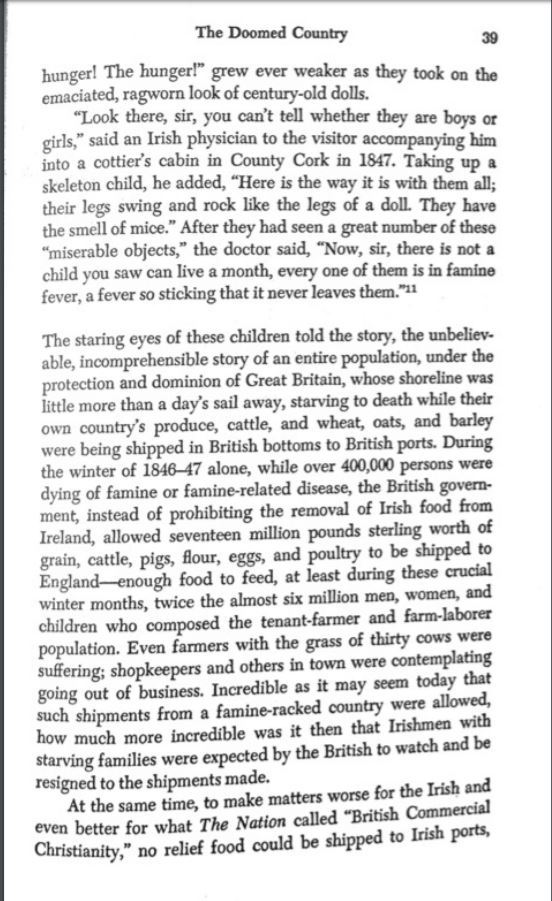
One of the greatest tragedies is that the starvation of millions could have been avoided. Contrary to popular belief, Ireland still produced enough food during the famine to feed its population. During the famine, the British continued to export food from Ireland to Britain. “…no issue has provoked so much anger or so embittered relations between the two countries (England and Ireland) as the indisputable fact that huge quantities of food were exported from Ireland to England throughout the period when the people of Ireland were dying of starvation”(Woodham-Smith). "The worst year of the Hunger, so bad it is remembered as “Black ’47,” while 400,000 men, women and children died, almost 4,000 ships carried food away from Ireland. Exported commodities included peas, beans, onions, rabbits, salmon, oysters, herring, lard, honey, tongues, animal skins, rags, shoes, soap, glue and seed, as well as butter"(Kinealy).
Moving Forward
It is said that we study history in order to not repeat it. But that is definitely not true. Since an Gorta Mór there have been several government-influence famines. Ukraine's Holomodor and The Great Chinese Famine to name two. There are still oppressive regimes in the world who seemingly take pleasure in causing their citizens suffering.
Our agricultural industry is, as a whole, becoming industrialized. Crops are becoming more genetically similar, making them more susceptible to disease. Regions are also specializing in crops they are most suited for for economic reasons, but the majority of their economy is tied up in it.
I think it is foolish to believe that nothing like an Gorta Mór will happen ever again, because in addition to these two factors, our planet's resources are being stretched further and further each passing year.
Bibliography
- Gallagher, Thomas Michael. Paddy's Lament: Ireland 1846-1847: Prelude to Hatred. Poolbeg, 1988.
- Beggar-Woman and Children, Illustrated London News, 12 August 1843
- Peasants at the Gate of a Workhouse, Illustrated London News, 1846
- Plan of a Workhouse, 5th Annual Report of the Poor Law Commissioners, 1838/1839
- Interior of a Workhouse, Illustrated London News, 1846
- Stack of Potatoes, Irish Times, 23 July 2013
- Kissane, Noel. The Irish Famine: A Documentary History. Dublin: The National Library of Ireland, 1995.
- Woodham-Smith, Cecil. The Great Hunger: Ireland, 1845-49. Penguin, 1991.
- Kinealy, Christine. A Death-Dealing Famine: The Great Hunger in Ireland. Pluto, 1997.